
How to Reconnect with Your Body: Learning to Listen Before It Has to Scream
Have you ever noticed the same pain returning again and again? A tight neck, an aching jaw, recurring migraines, digestive discomfort, or a deep fatigue that never quite goes away?
Perhaps your body has been trying to get your attention for a long time.
Most of us don’t ignore these signals because we don’t feel them—we ignore them because life keeps moving. There are responsibilities to manage, people to care for, deadlines to meet. We tell ourselves we’ll slow down later. That the pain will pass.
But our bodies are constantly communicating with us.
Every tension, every ache, every feeling of exhaustion can be an invitation to pause and listen. When we continually silence these messages, they often become louder until we’re no longer able to ignore them.
Learning how to reconnect with your body isn’t about becoming hyperaware of every sensation. It’s about rebuilding a relationship with yourself—one based on curiosity, compassion, and presence.
Understanding the Link Between the Body and Emotions
In yoga, we often say that the body is a temple. It’s a metaphor — but one that becomes deeply meaningful when we start to understand the intimate connection between the body, the mind, and emotions.
For those who feel drawn to spirituality, this temple can be seen as more than a physical structure, it is the vehicle of the soul, the sacred space through which we experience life. And like any temple, it deserves respect, care, and attention.
In yogic philosophy, the body doesn’t only allow us to move and act. It is also a place of memory. Everything we live through — what we feel, suppress, endure — leaves an imprint somewhere within us.
Yoga and Ayurvedic traditions teach that unexpressed emotions do not disappear. When they are not felt, expressed, or released, they accumulate and eventually manifest in the body as tension, pain, or even illness.
This is why movement, breath, and awareness are so central to these practices. They allow tensions to be released before they turn into deeper blockages.
Ancient yogic texts remind us that the body is the temple of the soul. It allows us to feel, to vibrate, to experience life in all its richness. When we neglect this temple — when we ignore its signals — we slowly lose our connection to ourselves. We risk living in a constant state of imbalance, exhaustion, or chronic stress.
Taking care of the body is therefore not only about physical comfort. It is an act of self-respect. A way of honoring our existence and restoring inner harmony and peace.
Why We Ignore the Signals (Until the Body Screams)
We often believe we’re disconnected from our bodies. But the truth is — we hear them.
We feel the tension. We sense when something is off. We just choose not to listen.We tell ourselves it will pass. We take a pill, apply heat and put a bandage over the pain.
But we treat the symptom, not the cause.
We wait until the pain becomes unbearable before taking concrete action.
Because addressing the root cause asks something uncomfortable of us. It asks us to slow down. To pause. To ask ourselves: why am I feeling this?
And that’s harder, it requires honesty. So we keep going and we push through. Until the body leaves us no choice. A mild back pain becomes chronic. Temporary fatigue turns into deep exhaustion. Ongoing stress leads to burnout.
The more we ignore the body, the louder it becomes. Just like life itself, which keeps presenting the same uncomfortable situations until we can no longer look away.
How to Start Listening More Deeply
How do we actually begin listening and understanding what the body is telling us?
Let’s be honest: it takes time. We were taught to push forward, to be productive, to hold it together. Especially as women, we often keep going at all costs, placing our needs last.
But if you’re here, reading this, perhaps a part of you is ready to do things differently.
Here are a few simple, gentle practices to begin reconnecting with your body.
1. Embodied mindfulness in daily life
Where do you feel tension? Is your body relaxed or contracted? How is your breath?
Over time, patterns begin to appear. Maybe your neck tightens during stressful days, or your stomach reacts when something feels off. This kind of observation, without trying to fix anything, is often the very first step back to yourself.
For the next seven days, try this daily check-in. No interpretation. Just noticing.
2. Move your body to release
What helped you once may not be what you need now. The goal isn’t discipline or performance, but resonance—listening to what your body asks for and allowing movement to become a form of dialogue rather than effort.
Choose the kind of movement that feels right for you. Dance. Shake. Walk in nature. Stretch. Jump. Let your body move in the way it needs to, so tension can be released rather than stored.
3. Use your breath as an anchor
By bringing gentle awareness to the breath—even for one minute—we can help the nervous system move from alertness to rest. The body relaxes. The mind slows.
For a week, whenever you notice tension or stress, pause and breathe consciously for a moment. Observe how your breath changes throughout the day.
4. Return through a body scan
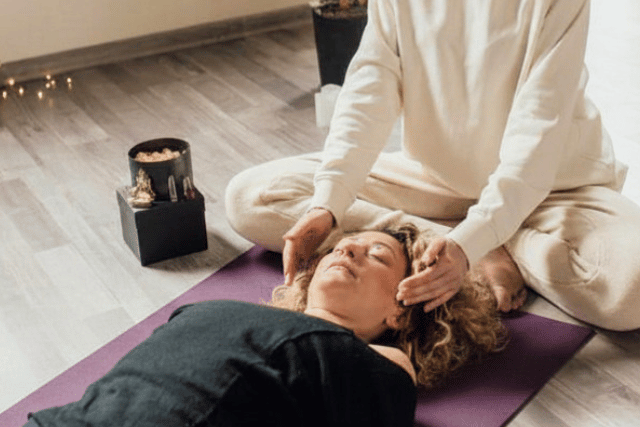
A body scan is a simple pause. A moment where attention gently shifts from the mind to the body—to observe, to feel, without judgment. It’s an accessible way to come back to yourself and to become aware of accumulated tension, of areas where energy feels stuck or constricted, and to begin allowing those places to soften.
Through this practice, you reconnect with your inner sensations and, perhaps more importantly, you create space to listen to what your body is trying to communicate. You may notice a tension you hadn’t been aware of before. Sometimes, simply bringing attention to a contracted area is enough for it to begin releasing on its own.
The body scan works on several levels. It helps calm stress, increases sensitivity to the body’s signals, supports the prevention of chronic tension, and anchors you in the present moment. It can be especially supportive before sleep, after a stressful day, or anytime you feel the need to come back to yourself.
Your body is your ally. It carries you through life, allows you to breathe, to move, to feel, to experience the world. And it speaks to you constantly—not to make your life harder, but to guide you back to balance.
Reconnecting with your body doesn’t require perfection or discipline. It begins with presence, and small consistent actions.
There is no “right” way to do this. What matters is finding what helps you feel more at home in your body.